Sunday, August 31, 2014

Snatching Defeat on Immigration

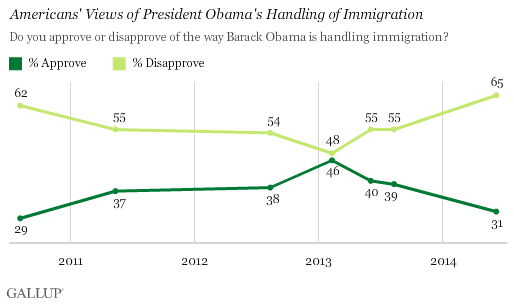
Congratulations, President Obama and my fellow Democrats. You have managed to turn a winning issue for our party - immigration - into a losing one. Poll after poll is showing strong opposition to the President's policies with respect to the immigration issue.

It has gotten so bad that the majority of Americans want less legal immigration, and independents have switch solidly into the Republican camp on this issue. How did Democrats screw this up so badly?

By betraying legal immigrants, and selling the farm on behalf of those who are in the US illegally. The Senate "Gang of Eight" bill has little for legal immigrants, and most of what might benefit them is offset by tens of billions of dollars of unfunded and wasteful security spending which will inevitably catch legal immigrants in its net. I especially love how they "solved" the problem of backlogs of up to twenty years for some visa types - not by speeding up the lines, but by eliminating those visa types completely! Brilliant!

What America needs is a full-throated, unabashed pro-legal-immigration party, a party that refutes the false and ugly claim (believed by 63% of Americans) that legal immigration harms the economy. Instead, we have an anti-immigration Republican party, and a Democratic party who only seems to care about securing another round of amnesty. Americans are siding with the former, and despite my extremely pro-immigration attitudes, I can certainly understand why. Hopefully my fellow liberals figure this out soon, or we are going to get hammered at the ballot box.


Saturday, August 30, 2014

Immigration and the Lump of Labor Fallacy

One very common (and bi-partisan!) argument I see against immigration is that it will lower wages of American workers. This meme is, fortunately, nonsense, as confirmed by numerous actual studies of real-world data. It is a classic example of what economists call the "Lump of Labor Fallacy" - the idea that there is a fixed pool of jobs, and if someone gets one, someone else does not. While this might be a sensible notion in one's very narrow experience, it is not true in the broader economy. If someone beats you out during the final interview round for a job, it is true that in the very short term, you are still out of work. However, the number of jobs in the economy does not decrease by one. Why? Because that someone will presumably spend their money from their new job, which will in turn create approximately one new job. If there were a million open positions across the US before the final interview round, there will still be a million the next day.

Immigration works the same way. Assuming for a moment that immigrants are more or less demographically matched to the native population in terms of education, age, etc, then any jobs they "take" will be made up for by the jobs they create when they spend their earnings. At first principle, this is a wash. In reality, immigrants are not demographically matched, so they can have impacts in specific labor markets where they are concentrated. If, for example, we were to allow a million dock workers to immigrate to the US, it is obvious that the wages of dock workers would fall. However, this would mean prices for goods passing through the docks would fall, which would in turn mean we'd all have a few more dollars in our pockets each month. When we spend this money, we'd create jobs all throughout the economy. How many? About as many as were lost by native dock workers! Likewise, the push to import a bunch of STEM workers will almost certainly depress wages for native STEM workers, but it means everyone else will be getting STEM products for cheap, saving us cash that we can then spend on other things. So while STEM workers have a right to complain, and may even deserve some sort of compensation or protection, overall, society wins.

If you can't see my point, let's try it another way. It should be obvious that population size of a country has essentially no impact on wages - there are plenty of counties of all sizes which are rich, and plenty which are poor. Therefore, to claim that immigration can lower wages is to claim that the economy somehow differentiates between population growth via border crossings and population growth via vagina crossings. That, of course, is absurd.


Thursday, July 3, 2014

Natural Gas Ain't Cheap...

One refrain I have been hearing a lot over the last few years is that natural gas is really cheap right now, and this will lead to some sort of economic bonanza. This would be nice, if the premise was true. Now, natural gas is certainly cheaper than it was in the aughts, but how does it compare historically? The EIA publishes all sorts of data on natural gas production and prices, but unfortunately does not have an inflation adjusted series, which is more relevant from a policy perspective. I have gone about constructing one, so that we can compare today's prices with those in the past.


I've chose to use the EIA's wellhead price, which was its longest running series until it was discontinued at the end of 2012. The prices in red are estimated from the city gate price, using a linear extrapolation based on the overlapping city gate and wellhead data from 2010-2012 using the regression formula

WH = (CG-2.9053)/0.7031

As you can see, wellhead natural gas is not unusually cheap. While it did very briefly touch historic lows near the beginning of 2012, it's average price over the last year of around $3.60 per tcf is similar to or higher than the real prices of natural gas in the late seventies and the period from 1985-2000.

But what about before the mid-seventies, you ask? Well, fortunately the EIA has less granular historical data going back to the 1920s! Again, I had to do the inflation adjustment myself, so here is their data in 2014 dollars.

  
Well I'll be. Natural gas was lot cheaper from the 1920's through the mid 1970's than it is today! Who would have guessed?

So no, natural gas is not cheap right now, nor does the futures market predict it ever will be again. It is highly unlikely we will ever return to the real price levels of the middle of the last century, or even to the somewhat elevated but still tolerable prices of the mid 80s and 90s. Instead, we will be faced with high prices in good years and insane prices in the rest. You'd better be ready for it.


Sunday, June 1, 2014

The Trouble with Game of Thrones, Season 5 (In One Chart)

Very light spoilers ahead....

The directors of Game of Thrones have said many times they were looking forward to Season 4, and dreading Season 5. Here is why.


By my count, there are currently nine plots running in the series, a "plot" being defined as a cluster of characters in a single location. The three major ones are the King's Landing / Lannister plot, the Jon / Wall plot, and the Daenerys / Slaver's Bay plot. Six smaller plots (Stannis and Company, Sansa/Littlefinger, Arya/Hound, Bran and Company, Brienne/Pod, and Ramsey/Theon/Yarra) round out the story. To film the series, the directors tend to focus on one of the three "main" plots each episode, filled with smaller scenes from some of the minor plots or the other two main plots.

As you can see, though, this breaks down in Season 5. If the books are followed, not only are two new significant plots born, but one of the main three splits into three and births another, one splits in two, and the other combines with an existing minor plot and then proceeds to split into five separate lines. At peak levels, there are many as seventeen separate plots going on simultaneously. Two of these do combine towards the end of book A Dance with Dragons (Book 5), and it is clear that many are converging early in Winds of Winter (Book 6), but as it stands, even with some significant pruning of characters and plots, there are some serious challenges to filming Season 5, as so many characters get divided and scattered to the winds. It will be interesting to see how the directors handle this challenge.

Note that this near-doubling of the plot lines is what underlies most of the criticism of the books A Feast for Crows and A Dance with Dragons. With that many threads going on at once, the pace of the overall plot seemed to slow down considerably.

PS: I'll give a small prize to the first person who can correctly decipher my graph!


Friday, May 30, 2014

Land of The Free, Baby, Yeah (IRS Edition)

A few weeks ago, I wrote a post comparing the Japanese immigration system to America's USCIS. Today, it is the IRS that is in my sights. My accountants just provided me with my US returns for 2013, and for the second year in a row (and completely predictably), the accountants cost more than my entire US tax burden.

How did things break down this year? My US returns were 70 pages long this year, beating out last year's 63 pages. In both years, the US collected a whopping 0.3% of my income*, a tiny tax liability I incurred either by traveling to the US on business or having some small US-source income streams that Japan didn't tax.

In contrast, my Japanese returns for the two years were 6 and 8 pages respectively, including things like cover letters. The actual returns are about as long as a 1040-EZ. The Japanese, of course, actually captured the lion's share of the taxes, around 17% of my income in both years. So just like in the immigration systems, Japan again wins hands-down in terms of simplicity and ease of complying with its laws. There is nothing like living in a true Land of the Free, rather than a false one.


...............................................................................................................................................................
*Note that payroll taxes are an entirely separate issue. I am only talking about income taxes. Fundamentally, I have a choice where to pay payroll tax, and I deliberately choose the US and participate in that system.


Saturday, May 17, 2014

Bicycle Helmet Laws

An interesting article appeared on Vox today and was followed up on Treehugger. The basic argument, which I find compelling, is that mandatory bicycle helmet laws do more harm than good, despite the rather obvious fact that helmets do indeed reduce injuries in the event of an accident. There are several major reasons for this

1: Automobile drivers have been shown to be more aggressive around cyclists with helmets (and interestingly, males) than those without helmets. This increases risks for the cyclists and partially offsets the benefit of wearing the helmet.

2: Mandatory helmet laws significantly decrease bicycle ridership. This has two negative effects

   2A: Cycling is a very healthy activity. Fewer cyclists implies more heart disease, diabetes, etc
   2B: Fewer cyclists on the road increases the risk for those who remain due to some combination of inferior infrastructure and lack of attention by automobile drivers, who are not used to looking for cyclists in areas with low ridership

The combination of 1 and 2B leads to the somewhat counter-intuitive result that while helmets have been clearly shown to be effective in preventing injury, mandating them does not reduce the injury rate on the population level. Add in the costs associated with 2A, and these laws actually appear to be a net negative for the public. It is generally my opinion (one that I hope most people share) that the government should only restrict peoples' freedom when there is a compelling case to do so. I just don't see how you can make a compelling case here, as it appears the non-cycling portion of the public is actually worse off, not better off, due to these laws.

One other point in the article that I found interesting was the similarity in injury rates per hour for walking, cycling, and driving. It's actually rather hard to defend a cycling helmet law without implying that pedestrians and drivers should have to wear helmets as well. Can you really imagine demanding drivers where helmets in the car, or pedestrians don them before crossing the street?

 A typical Japanese bicycle ride


Tuesday, May 13, 2014

Why Illegal Immigrants Ignore the Law

I just received my third 3-year work visa for Japan. My Japanese wife has a permanent residency in the USA. Here is a breakdown of the costs of my three visas vs her green card:

Item
My three Japanese work visas (combined)
Wife’s green card
Dollar cost (1)
$325
$16,000
Hours spent (2)
30
200
Days taken off work
1.5
30
Processing time
8 days (renewal) or 3 weeks (initial)
3-5 months (visa) or 6-12 months (green card)
Pages of documentation
20
400
Forced unemployment (3)
0
4 months
TSA-style security screenings
2
15
Very thorough health screenings
0
1
Forced international trips
0
5
Immigration office visits
Any office, any time within a broad range
Time and place mandated by USCIS
Immigration officer behavior
“Welcome back” – in English
Hostile questioning about technical immigration details – in English
Senatorial interventions(4)
0
1
Times anyone was reduced to tears upon (re)entry
0
1
Why do immigrants flout our rules? Because our rules are utterly ridiculous. This, and not "security porkulus in exchange for amnesty" should be what our immigration debate is about.


..............................................................................................................................................


1: Total dollars or yen spent by myself, my wife or my employer on application fees, medical or biometrics screenings, documentation, legal fees, and travel
2: Total time spent by myself, my wife, or my employer's staff
3: This results from the time gap between arrival in the US and receipt of a work permit that all family-based immigrants must endure, unless they have a work permit for independent reasons
4: Thank you, Senator Brown of Ohio and staff, for making this process "easier" than it otherwise would have been